
The Airport Kept Flying. Its Check-in System Was Still Being Rebuilt.
A ransomware attack on Collins Aerospace disrupted passenger processing across European airports. Berlin’s records reveal two recoveries: keeping flights moving and safely reconnecting the software on which normal service depended.
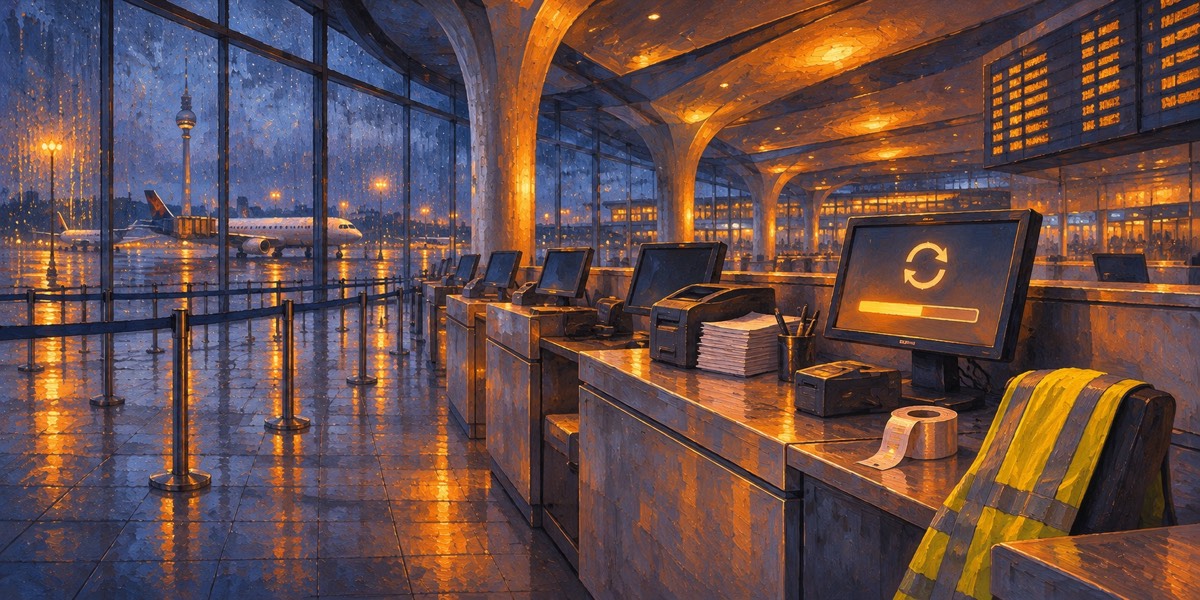
Nearly two weeks after the disruption began, Berlin Brandenburg Airport was describing a recovery still to come. On October 2, 2025, it said its supplier aimed to restore the central handling system by October 5. Security testing would follow. Airlines, counters and boarding gates would then be reconnected in stages.
At the same time, almost all flights were operating. Staff and airline partners had kept the airport moving through exceptional arrangements. The airport’s recovery notice described continuing waits at check-in, boarding and baggage reclaim. Maintaining departures was not the same as restoring the system that normally made them routine.
That distinction is the revealing feature of the Collins Aerospace attack. A disruption at a shared technology supplier spread into separate airports and airlines, but its effects were uneven. The presence of backup procedures prevented a complete halt without making the incident disappear for travelers or employees.
Collins’s parent, RTX, disclosed that it became aware of ransomware on September 19. Its September 24 securities filing identified systems supporting MUSE, the Multi-User System Environment. The software lets airlines share check-in and gate resources, including baggage handling. RTX said the airport systems resided on customer-specific networks outside its enterprise network.
The company activated its response plan, brought in cybersecurity specialists and notified authorities. Customers moved to backup or manual processes and experienced delays and cancellations. RTX said the incident had not materially affected, and was not reasonably expected to materially affect, its own financial condition or business results. That assessment concerned the corporate group. It did not measure the costs borne by every airport, airline or delayed passenger.
Recovery Behind the Departure Board
The interruption lasted beyond the first weekend. On September 24, Reuters reported that Collins was working to restore its on-site passenger-processing software while Berlin warned of further disruption. Restoring a product and putting each customer safely back onto it were separate tasks.
Travelers experienced the gap in hours rather than software milestones. Sky News’s contemporaneous reporting described Tereza Pultarova waiting roughly ten hours at Heathrow after arriving early for a journey to Cape Town through Amsterdam. Another passenger, Maria Casey, reported a three-hour baggage-drop wait. Sky attributed those accounts to the passengers. They show consequences an airport’s monthly passenger total cannot describe.
Berlin’s October 8 traffic report nevertheless recorded almost 2.5 million September passengers, around 24,000 more than a year earlier. It said almost all flights had operated and the attack had not significantly affected traffic statistics. That is evidence of operational resilience, not evidence that the disruption cost nothing. A completed journey and an uncomplicated journey count equally in a passenger total.
A Criminal Inquiry Is a Different Recovery Track
British investigators made an arrest quickly. The National Crime Agency announced on September 24 that a man in his forties had been arrested in West Sussex the previous evening on suspicion of Computer Misuse Act offenses and released on conditional bail. The agency described an early-stage investigation. That historical announcement does not establish a later conviction or the suspect’s present status.
A 2026 working paper from the German Institute for International and Security Affairs, drawing on the EuRepoC incident repository as of February 3, adds complexity to attribution. It records a claim by the Everest group that it breached the provider but did not deploy ransomware, and discusses the possibility of another intrusion. Those are competing reported accounts, not an established identification of every attacker. Those accounts do not establish a state-directed operation or a conviction.
The strongest documented story is less tidy than an airport shutdown followed by a restart. Flights continued, passengers waited, bags needed tracing, software required testing and a criminal investigation followed its own course. Berlin’s recovery plan shows why a departure board can look close to normal while the infrastructure behind it is still being rebuilt.
Compiled November 16, 2026. Records and findings keep the dates stated in their sources; each link in the text opens the document it relies on.