
The Order to Film Came Before Warsaw’s Marywilska44 Shopping Center Burned
Polish prosecutors describe advance instructions to record the Marywilska44 fire and send the footage for Russian propaganda. The case separates those accused of causing damage, documenting it and seeking to circulate the result.
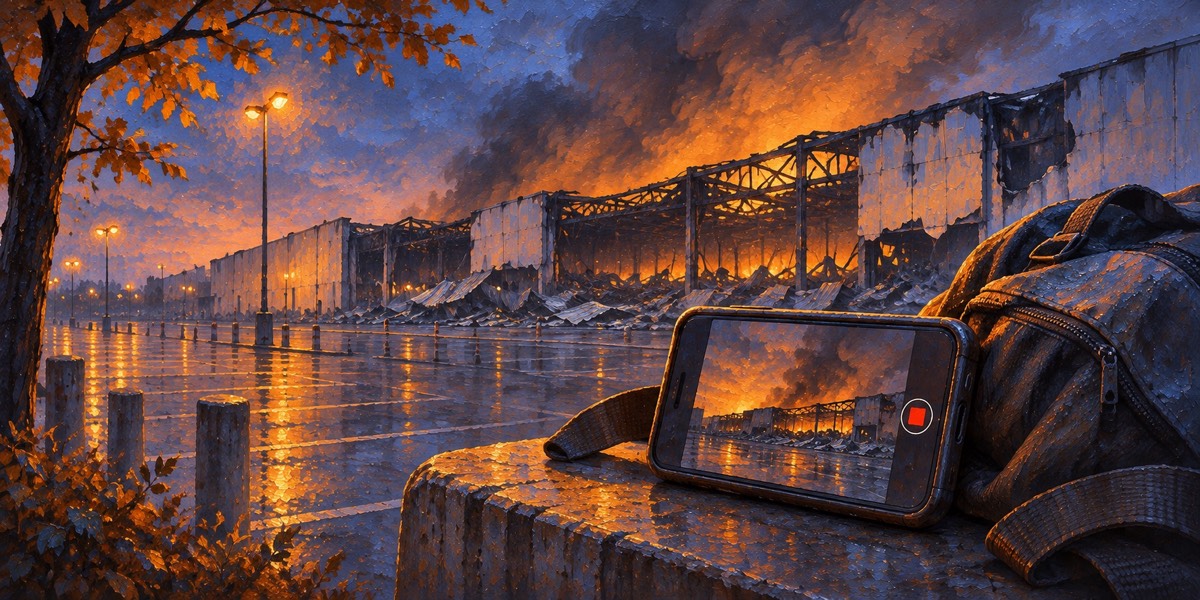
On May 11, 2024, the day before fire swept through the Marywilska44 shopping center in Warsaw, someone was instructed to go there and film at the time the blaze was expected to begin, according to Polish prosecutors. The camera received its assignment before firefighters received their emergency call.
In the prosecution’s May 2025 account, the video had two intended purposes: confirmation that the task had been completed and publication on Russian propaganda websites. This was not simply a passerby deciding to film a fire already underway. Prosecutors allege that recording was commissioned as part of the operation and that the handler issuing instructions was in Russia.
The center contained approximately 1,400 shops and service outlets belonging to more than 700 traders, according to Polish reporting. Those figures show how many livelihoods were concentrated in one place. Against that commercial scale, prosecutors describe an individual whose local task was to arrive on time and transmit an image of the result.
The cause was not presented as known from the outset. The May 13, 2024 announcement opening the investigation described circumstances still being examined. The later attribution emerged from the investigation that followed; it does not turn the uncertainty of the first day into knowledge supposedly concealed from the public.
A person instructed to film is not necessarily the person who starts the fire. Here, that distinction is explicit. The prosecution’s April 2026 announcement of an indictment said the direct perpetrators of the Marywilska44 arson had not yet been identified and the investigation into them continued. The case therefore separates documenting the attack from carrying it out.
A Recording for the Handler—and an Audience
The recording can serve different purposes at different points in the chain. For a handler, it can confirm that something happened at the designated place and time. For an audience, it can turn a local event into a message presented in another country and language. Prosecutors say both purposes appeared in the instruction. That does not measure how many people saw the footage or changed their views because of it.
For the shopping center’s traders, the commercial injury did not depend on any later audience. The alleged order sought a second result beyond the destruction itself: a record that another person could use. Evidence about that purpose must still be distinguished from evidence of its eventual effect. The company and its tenants bore the immediate consequences at the site itself.
The legal proceedings also split into separate tracks. In September 2025, three people were convicted of membership in an organized group, two also of obstructing an investigation. The announcement was published in October. At publication, the judgment was not final. These were not convictions of the shopping center’s direct arsonists, even though the proceedings formed part of the wider investigation.
A further indictment against five people was filed in March 2026 and described in the prosecution’s April announcement. It concerned several sabotage incidents, not just the Warsaw fire. PAP reported that a trial connected to this sequence opened in October and that the court excluded the public on important state-interest grounds. One defendant’s case was separated because, according to the prosecutor, he had not yet been transferred from Lithuania.
The number indicted is therefore not necessarily the number tried together, and the number convicted of group membership is not the number of arsonists. These distinctions reflect an investigation connecting different roles and events without turning them into a single act by a uniform group.
The fire damaged a major commercial center. Within the prosecution’s account is a smaller, precise assignment: someone was sent to stand before the result and pass it on. That links sabotage to content production without putting the camera and the means of ignition in the same hands. When the filming order comes before the fire, the image is not merely what survives the attack. It is one of the products the person commissioning it wanted delivered.
Compiled November 16, 2026. Records and findings keep the dates stated in their sources; each link in the text opens the document it relies on.