

Renault’s Systems Stayed Intact. Its Customers’ Vehicle Details Were Stolen Elsewhere.
A supplier breach exposed information connecting UK customers to their cars. Renault and Dacia warned affected people while withholding the provider’s identity, illustrating how a carmaker’s customer records can be lost outside its own network.
The letter told Renault customers that the company’s own systems had not been compromised. A few paragraphs earlier, it told them that information about them had been taken from a third-party provider. Both statements described the same incident.
The customer notice, published with contemporaneous reporting in October 2025, listed names, contact details and vehicle information among the data the attackers could access. The fields included vehicle identification and registration numbers: information linking a person to a particular car.
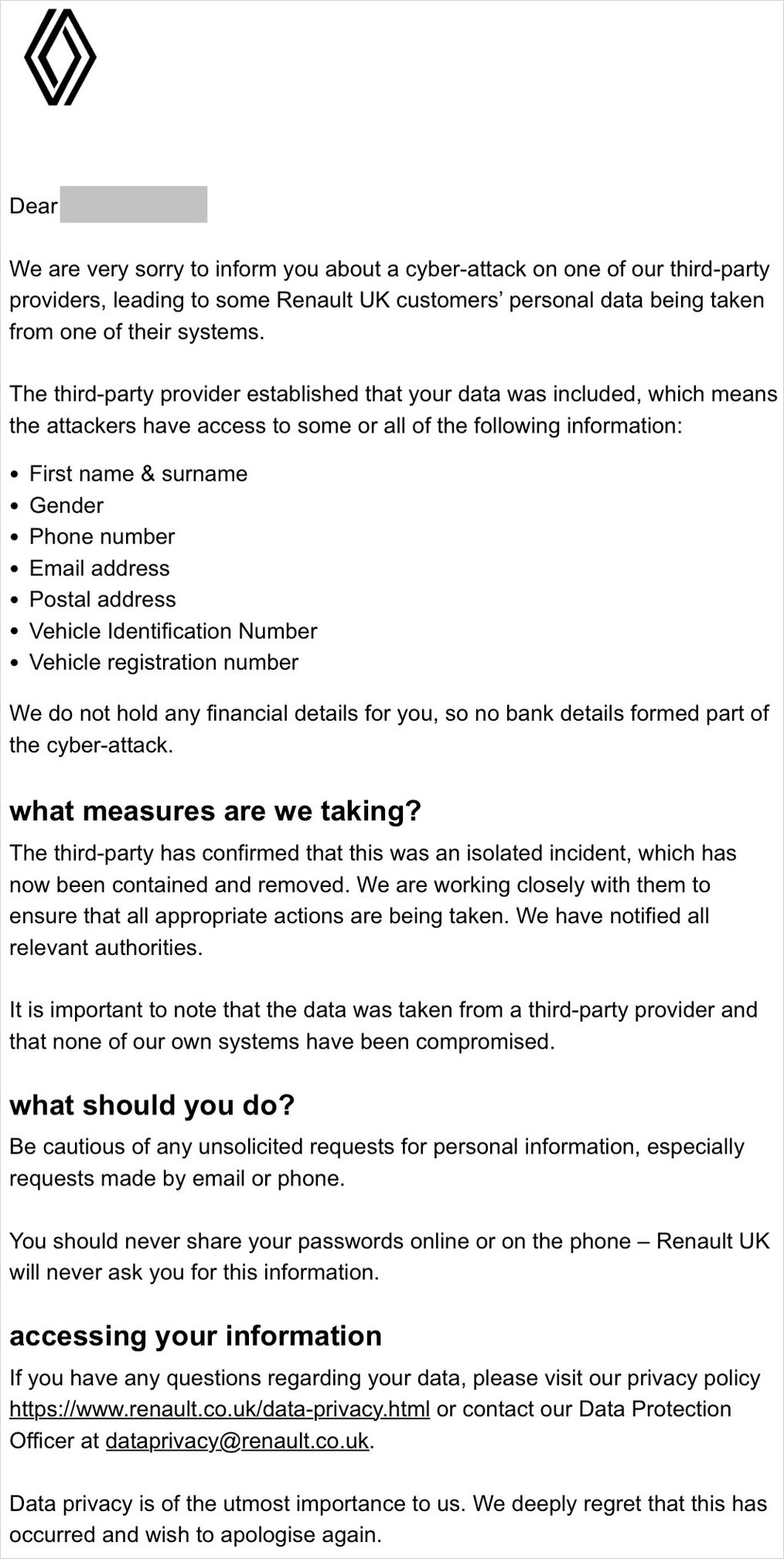
Renault’s assurance about its own systems limited the known technical intrusion. It did not limit the breach to someone else’s customers. The people receiving the warning had shared information with Renault; their records had subsequently been held inside the provider’s systems.
The Car Was Part of the Record
Sky News’s October 3 report recorded Renault UK’s confirmation that customer information had been accessed. The company said no financial information or passwords had been compromised, that its internal systems were unaffected and that manufacturing had not been interrupted.
That is a different consequence from an attack that halts a vehicle plant. It concerns the relationship with people who buy, service or otherwise interact with a car brand. A vehicle number attached to a name and contact details can make an unsolicited approach appear knowledgeable. It does not, by itself, give an attacker control of the vehicle or establish that a particular recipient has already been defrauded.
Dacia customers received notices too. BleepingComputer’s account described messages sent by both brands and reproduced the Renault notification. The company told the publication that the number of affected clients was not yet available and that a contractual agreement prevented it from disclosing the provider’s name.
That was the company’s explanation for the missing name, not an independent determination of what the contract legally required. It left customers with an identified brand to contact and an unidentified service provider at the site of the intrusion.
The Outsourcing Was Ordinary. The Access Was Not.
Renault’s UK privacy notice describes a broad network of authorized processing. Providers may host or maintain databases and websites, handle customer relations, support marketing, organize competitions or conduct studies. The company says it secures these relationships with contracts, audits, guarantees and security tests.
The notice does not identify which of those functions the affected provider performed. Nor does it prove that a safeguard worked or failed in the incident. It explains the commercial arrangement through which a company can remain responsible for communicating with people whose information is processed somewhere else.
The range of services also helps explain why an affected-data population need not correspond exactly to a list of people currently driving the brand’s cars. A company can collect information in several kinds of interaction. The incident notice still has to establish which particular records were involved; a general privacy policy cannot supply the missing victim count.
Renault said the provider had contained the incident and removed the threat. Authorities were notified, and the company said it was working with the provider on the response. Those statements concern the handling of the intrusion. They do not establish that every copy of the information had been recovered or that no unauthorized person retained it.
The Regulatory Record Has Its Own Limits
In a December 24, 2025 freedom-of-information response, Britain’s Information Commissioner’s Office confirmed receiving two personal-data breach reports from Renault UK since that January. It pointed to published data for one and withheld details of the other, saying an investigation was ongoing at the time.
The ICO did not identify that second report as the October supplier incident. Its response was not a finding against the unnamed provider, and its December 2025 description does not establish the investigation’s position eleven months later.
For the affected customer, the immediate information was more concrete. A familiar brand had sent a notice containing two messages: its own network had remained intact, and information connecting that customer to a vehicle had nevertheless been taken. The supplier boundary mattered to the technical account. It did not keep the loss of information on the supplier’s side of the relationship.
Compiled November 16, 2026. Records and findings keep the dates stated in their sources; each link in the text opens the document it relies on.