
Tesla’s Power Line Also Served Its Neighbors
An arson attack outside the German factory disrupted nearby communities and services. The case exposes the shared infrastructure behind a corporate target—and the distance between a group’s name and the identities of its members.
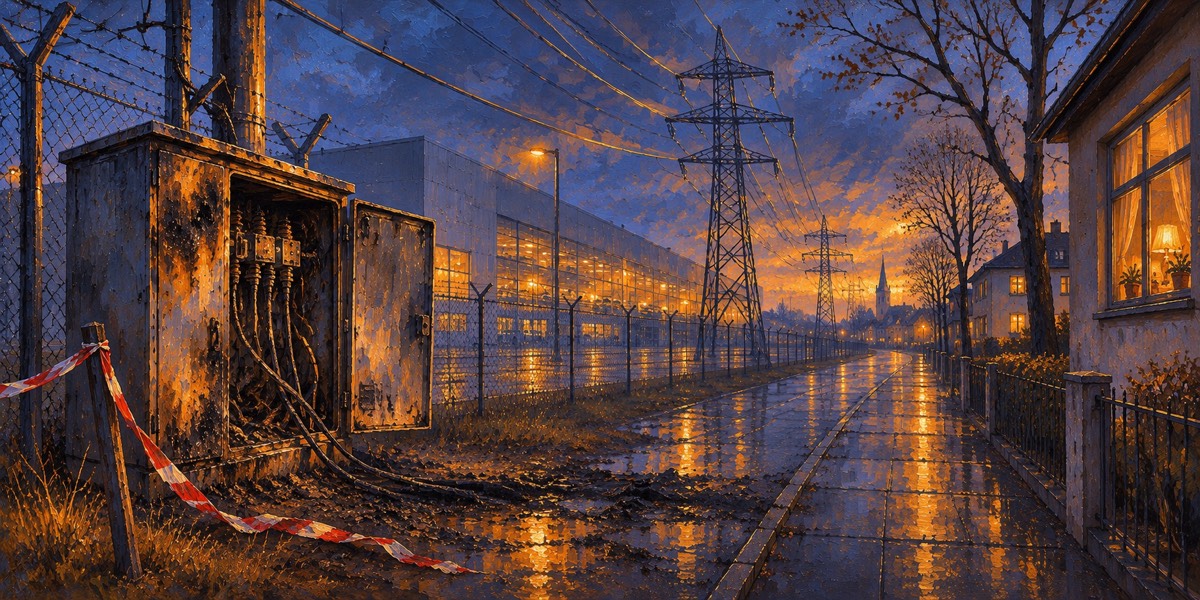
The damage was outside the factory fence. On March 5, 2024, Brandenburg’s interior ministry confirmed that an arson attack on electricity infrastructure had cut power to Tesla’s plant and nearby communities. The network supplying the factory also supplied people and services that had not chosen to take sides in the conflict surrounding it.
Associated Press reporting described effects on care facilities and a logistics site. The damage therefore cannot be measured solely by the number of cars not produced. Infrastructure supporting a large corporation can simultaneously serve homes, public services and other businesses. A disruption at a shared point branches into several patterns of life and work.
On the day of the attack, the ministry cautioned against speculation about the perpetrators. Federal prosecutors later took over the investigation on initial suspicion of offenses including sabotage, arson and membership in a terrorist organization. A group calling itself Vulkangruppe claimed responsibility; reporting said police considered the claim authentic.
A statement investigators regard as authentic is one kind of evidence. Identifying who wrote it, prepared the attack or went to the site is another task. A name can communicate an ideological message without supplying the public with a membership list, command structure or proven connection to a foreign state.
Brandenburg police had already investigated damage in May 2021 to power cables serving the factory’s construction site and parts of the surrounding community. The similarity of the targets provides context, not proof of the same perpetrators. Connecting attacks around the same facility requires evidence beyond a similar target or group name.
What Investigators Knew at the Time
In a February 2026 government response, authorities said one residential search had been conducted in the investigation into the 2024 Tesla attack. At that point, there were no final convictions in federal prosecution cases connected with Vulkangruppen. That was a dated account within the particular jurisdiction covered by the question, not a verified description of every proceeding in November.
A separate Berlin incident was discussed at a Bundestag committee in January 2026. A federal prosecution representative said there were no findings confirming state involvement in the incident under discussion, without ruling out that possibility. He considered partial overlap with groups involved in earlier attacks on Tesla possible but said the structure and membership had not been clarified.
That testimony does not establish Russian responsibility. It describes an investigation in which possible connections remained short of proven identification. Equally, an attack on a factory for political reasons does not make every protest around it part of the same criminal activity. The target, alleged motive and perpetrator’s identity must each be examined separately.
On the financial side, a manufacturer’s estimate of interrupted production is not a final account of all damage. A resident without power and a facility needing backup are not automatically included in the number of cars that failed to leave the production line. Measuring the wider civilian impact requires records from network operators and affected organizations, not only the most prominent corporation’s estimate.
The problem extends beyond identifying the attackers. When shared infrastructure is attacked in opposition to a large target, people outside it also bear the consequences. An attacker can select a factory as a target. The electricity network cannot be redrawn to make the damage stop at its fence.
Compiled November 16, 2026. Records and findings keep the dates stated in their sources; each link in the text opens the document it relies on.