
The Claim and the Bill: A Rail Cable Fire Near Düsseldorf, and What Nobody Counted
In July 2025, arsonists cut one of Germany’s busiest rail lines and 385 trains were diverted. A group posted a claim online; nobody has been arrested. The state government says it has no tally of the cost, and the railway does not record what such disruptions cost at all.
In 60 seconds
In July 2025, someone set fire to railway cables between Düsseldorf and Duisburg in western Germany. Hundreds of trains had to change route and tens of thousands of people were delayed. A left-wing extremist group said online that it did it, but nobody has been arrested, and officials say they cannot yet be sure who was behind this kind of attack. The state government says it has no figure for what the attack cost, and the railway company doesn’t record the cost of disruptions like this at all.
Key points
- On July 31, 2025, two incendiary devices set fire to signal cables on the Düsseldorf–Duisburg line, one of Germany’s busiest. Deutsche Bahn says 385 trains were diverted over two days; nobody was hurt.
- A text signed “Kommando Angry Birds” claimed the attack on Indymedia. The state classified it as left-wing crime “on the findings so far.” Claim only
- No one has been arrested. The investigation is against unknown persons, and the federal government says no clear attribution has yet been possible in the recent cable attacks.
- The state government says it has no tally of the costs, and Deutsche Bahn records no economic damage for such disruptions.
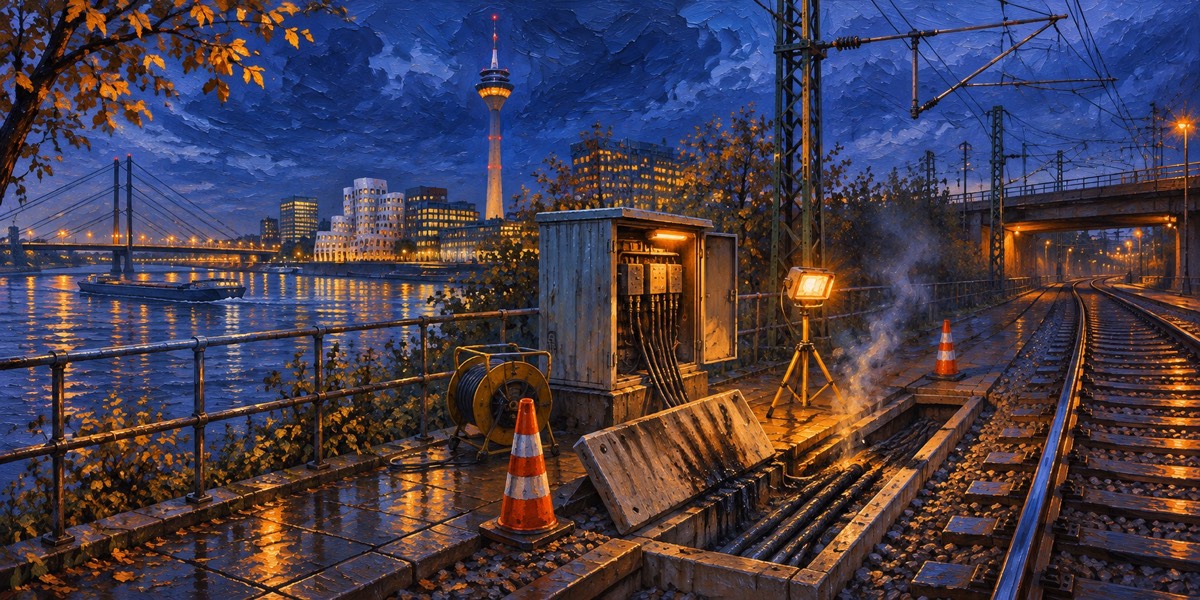
On the morning of July 31, 2025, two incendiary devices that had been placed in cable ducts beside the railway north of Düsseldorf airport caught fire, about two kilometres apart. The line between the airport’s long-distance station and Duisburg-Großenbaum, part of one of the busiest rail routes in Germany, had to be shut down. Nobody was hurt; there was “at no time” a danger to life, the Düsseldorf prosecutor’s office reported to the state parliament (Interior Committee minutes, translated).
The cables belonged to a signal box in Duisburg. They had to be replaced over a length of 60 metres, and two more damaged cables were found, making repairs more complicated than expected, a Deutsche Bahn spokesman said. Tens of thousands of travellers were likely to be affected (ZDF, translated). The second fire site, 1.8 kilometres north near Angermund, was found only the next day; police said they presumed “both attacks were carried out at the same time” (DW). Restrictions lasted until August 2.
The route normally carries 700 to 800 connections a day (DW). On July 31, many travellers were stranded at Duisburg and Düsseldorf main stations, and there were numerous cancellations and delays. Some long-distance trains were diverted from as far away as Dortmund via Wuppertal, and the railway set up shuttle buses between Düsseldorf airport and Duisburg (ZDF, translated). DW reported that the interior minister described the group as known to the authorities, and that the claim posted on July 31 referred to “several attacks” in the Düsseldorf region (DW).
The same day, a text appeared on the website de.indymedia.org, signed “Kommando Angry Birds,” claiming the attack and justifying it by a “priority interest of nature over economy and industry” (minutes, translated). Two months later, the state government told parliament two things that frame this story. It had assigned the case, “on the findings so far,” to left-wing politically motivated crime. And it had no tally of what the attack had cost (Drucksache 18/15926, translated).
July 31, 2025NRW Landtag, Interior Committee minutes APr 18/1013, October 2, 2025, page 44ZDF, August 1, 2025DW, August 1, 2025NRW government answer, Drucksache 18/15926
What the government actually said
The written answer, dated September 30, 2025, responded to a question from two AfD members of the state parliament (question 18/15312). It was signed by the state’s minister for the environment, nature conservation and transport, in agreement with the interior and justice ministers. It is two pages long and carefully worded. Most of it is reported speech: the senior public prosecutor in Düsseldorf had told the justice ministry that an investigation was under way “against unknown persons” for intentional arson, disruption of public services and anti-constitutional sabotage. On Indymedia, a text “was said to have been published” in which the authors claimed the act. “The investigations were continuing” (Drucksache 18/15926, translated).
Asked which political direction the case belonged to, the government replied: “On the findings so far, the matter is assigned to left-wing politically motivated crime.” Asked how many trains were affected, it passed on a Deutsche Bahn figure: according to the company’s statement of August 25, 2025, “a total of 385 trains were diverted” between July 31 and August 1. Asked what the sabotage had cost the economy, it said: “The state government has no itemization of the economic costs caused by the sabotage” (Drucksache 18/15926, translated).
Three details are worth noticing. The train figure is Deutsche Bahn’s, not the state’s, and it covers diversions only, not cancellations or delays. Deutsche Bahn’s own term for the event, as quoted in the answer, is “vandalism damage.” And the political classification is explicitly provisional.
The written answerNRW Landtag, question 18/15312NRW government answer 18/15926, September 30, 2025
How far a claim carries
No one has been arrested for the July 31 attack. A year after the attack, ZDF reported that “so far no member of the left-wing extremist group has been caught,” and that the size of the organization is not known (ZDF, translated). The case rests on a text posted on an open website.
That has not stopped the claim from hardening into fact in official writing. The state’s report on the protection of the constitution for 2025 states: “The left-wing extremist group Kommando Angry Birds carried out an arson attack on July 31, 2025 on Deutsche Bahn’s main north-south line between Duisburg and Düsseldorf” (NRW Verfassungsschutzbericht 2025, translated). The federal domestic intelligence service lists the attack, at the end of July 2025, among those the group has claimed (BfV).
The state’s interior minister was more careful in front of the committee. Asked about a series of attacks on the railway that summer and autumn, Herbert Reul said that in one case, because of a claim letter, it was known “with certainty” that the perpetrators came from the left-wing extremist spectrum, though that did not mean it was the only such case. Russian actors, he said, were always among the suspects in his experience; pranks could never be ruled out with certainty; and copper thieves also regularly damaged cables. On Russian recruitment of saboteurs for the railways, he said: “We have no concrete evidence for that at the moment” (minutes, translated).
The federal government has been more cautious still. In October 2025 it told the Bundestag that in the recent attacks on cable shafts and supply lines “no clear attribution to perpetrators has yet been possible” (Drucksache 21/2067, translated).
A claim of responsibility is evidence. It is not proof of who acted, or of whether the authors and the arsonists are the same people. In this case it is, so far, the only evidence that has been made public. Compare a cable fire in Berlin’s Wuhlheide in January 2025, where, CORRECTIV reports, police assessed a claim letter from the left-wing extremist scene as genuine ([CORRECTIV]({COR}), translated). No such public assessment of authenticity has been reported for the Düsseldorf claim.
AttributionZDF, July 2026NRW Verfassungsschutzbericht 2025 (mirror)BfV, January 2026NRW Landtag, APr 18/1013, pages 41-44Bundestag, Drucksache 21/2067
Not one incident, but a season
Reul listed what North Rhine-Westphalia had seen that year: arson in Essen on July 16; Düsseldorf on July 31; a fire on the line in Wuppertal on August 22; arson in Heinsberg on August 28; an attempted dangerous interference with rail traffic in Wuppertal on August 30; arson in Essen on September 12 and in Oberhausen on September 18; cables cut in Leverkusen and Herzogenrath on September 22; and another arson attack in Heinsberg on September 23 (minutes).
Only one of these, by his account, came with a claim letter. The only cost figure in the whole report to the committee is for Herzogenrath, where cut fibre-optic cables caused damage estimated by police at 2,500 euros. That cut caused no disruption to trains. The next night, a cable shaft at a level crossing near Heinsberg was set on fire, melting the cables and knocking out the technical monitoring of the line for several hours. The Aachen prosecutor is investigating both cases against unknown persons on suspicion of attempted murder and dangerous interference with rail traffic; the background, the prosecutor reported, is “so far unexplained” (minutes, translated).
The pattern has continued. In July 2026, fires damaged several signal cables on the embankment between Langenfeld and Leverkusen on the Cologne–Düsseldorf line; Reul told ZDF that on current knowledge it “must be classified as an action by left-wing extremists, above all because there have been comparable acts” (ZDF, translated). Nationally, the Federal Criminal Police Office counted 93 offences against transport infrastructure as targeted sabotage in 2025, up from 58 in 2024 and 78 in 2023, according to figures it gave to CORRECTIV. Most of those 2025 cases were not attributed to the left at all: the largest category, 37 cases, was “other attribution,” ahead of 18 suspected left-wing, 12 foreign and 10 right-wing offences. Behind the national total, in other words, the question of who did it is usually open.
The 2025 seriesNRW Landtag, APr 18/1013, pages 41-48ZDF, July 2026CORRECTIV, June 18, 2026
The cost nobody records
The state government’s answer on costs was not an oversight. It reflects how the system works. In October 2025, answering a separate question in the Bundestag, the federal government passed on Deutsche Bahn’s position: in disruptions to operations, “for example due to faults in control and signalling technology, no economic damages are recorded, according to DB AG” (Drucksache 21/2143, translated).
Strikes, by contrast, are counted: the same answer gives revenue losses of 35.7 million euros in 2023 and 40.5 million in 2024. Delays caused by outside interference are counted too, in a category called “Fremdeinwirkung”: about 2.35 million minutes in 2022, 2.02 million in 2023 and 1.93 million in 2024. But that category mixes sabotage with trespassing and other causes, and “operational data contain no information about the perpetrators or their motivation” (Drucksache 21/2143, translated).
At the federal level, the number of sabotage cases against energy and transport infrastructure since 2020 has been classified “for official use only.” The Federal Prosecutor General could not even provide a count: “suspected sabotage against energy or transport infrastructure since 2020 in Germany” is “not a criterion that is kept in the procedural registers” of the federal prosecutor, and answering would require “a manual evaluation of an immense body of files” (Drucksache 21/2067, translated). Asked about the economic damage, the federal government said: “The federal government has no knowledge of this” (Drucksache 21/2067, translated).
What exists are general figures. Vandalism caused Deutsche Bahn 34 million euros in damage in the previous year, 19.6 million of it to infrastructure, according to a federal transport ministry answer reported by dpa in August 2026 (Volksstimme).
The federal domestic intelligence service says that left-wing extremists cause damage “in the multi-digit millions” each year through attacks on critical infrastructure and businesses (BfV, translated). The state report says the July 31 attack caused “a high sum of damage for Deutsche Bahn” and serious restrictions, “train cancellations and hours-long delays,” for tens of thousands of travellers until August 2, without giving a figure. Of an earlier attack on the Cologne–Düsseldorf freight line in January 2025, it says: “There was high property damage, the specific amount of which is unknown” (NRW Verfassungsschutzbericht 2025, translated).
So the travellers stranded at Duisburg and Düsseldorf on July 31, the commuters put on replacement buses, the repair crews and the freight that waited are all real, and all uncounted. “Clearly, these acts cost a heap of money, do great damage, and annoy rail passengers who depend on their train to get to work,” Reul told the committee (minutes, translated). He did not say how much, because no one in government knows.
CostsBundestag, Drucksache 21/2143, October 9, 2025Bundestag, Drucksache 21/2067, October 8, 2025Volksstimme (dpa), August 2026BfV, January 2026NRW Verfassungsschutzbericht 2025NRW Landtag, APr 18/1013
What has changed
Germany’s law on the resilience of critical infrastructure, the KRITIS-Dachgesetz, has been in force since March 2026 (federal government). It sets out which companies count as critical infrastructure and requires them to protect their facilities and report incidents. It does not require anyone to publish how many attacks there were, who was found responsible, or what they cost.
The Düsseldorf case remains open, against unknown persons, more than fifteen months on. A claim has been posted, accepted by intelligence reports and never tested in court. The bill has been paid by a rail company, its passengers and the public purse in pieces that no one has added up. That is not a failure of one investigation. It is how the record is kept.
LawFederal government, KRITIS-Dachgesetz
What is established, and what is not
Established
- Signal cables on line 2650 were set on fire at two points about two kilometres apart on July 31, 2025; there was no danger to life (Düsseldorf prosecutor).
- Deutsche Bahn says 385 trains were diverted on July 31 and August 1, 2025.
- A claim signed “Kommando Angry Birds” was posted on Indymedia; the investigation is against unknown persons. Claim only
- The state government has no itemization of the economic costs.
Not established
- Who set the fires, and whether the authors of the claim are the same people.
- What the repair, the diversions, cancellations and delays cost Deutsche Bahn and its passengers.
- How many trains were cancelled or delayed, as opposed to diverted.
- Whether the attacks in Essen, Wuppertal, Heinsberg and elsewhere are connected.
- How many sabotage cases there have been nationally; the federal count is classified.
Sources
- July 31, 2025
- The written answer
- Attribution
- The 2025 series
- Costs
- Law
For journalists and researchers
Key facts, citable
- Deutsche Bahn: 385 trains were diverted between July 31 and August 1, 2025 after the cable fire between Duisburg and Düsseldorf. Source
- The NRW government: “The state government has no itemization of the economic costs caused by the sabotage.” Source
- The case is assigned to left-wing politically motivated crime “on the findings so far”; the investigation is against unknown persons. Source
- Federal government: in operational disruptions, DB records no economic damages. Source
- The BKA counted 93 targeted sabotage offences against German transport infrastructure in 2025. Source
Primary documents
- NRW government answer, Drucksache 18/15926
- NRW Landtag, Interior Committee minutes APr 18/1013
- Bundestag, Drucksache 21/2143
- Bundestag, Drucksache 21/2067
- BfV, attacks by left-wing extremists on critical infrastructure
Cite this
Researchez. “The Claim and the Bill: A Rail Cable Fire Near Düsseldorf, and What Nobody Counted.” Researchez, November 20, 2026. https://www.middleeastinfo.org/article-duisburg-rail-cable-fire.
Researchez. (2026, November 20). The Claim and the Bill: A Rail Cable Fire Near Düsseldorf, and What Nobody Counted. Researchez. https://www.middleeastinfo.org/article-duisburg-rail-cable-fire
https://www.middleeastinfo.org/article-duisburg-rail-cable-fire
Reuse
This report may be republished in full and without changes under CC BY-ND 4.0, with the credit line on Republish our work. Translations, edits and exclusive or paid use are by agreement: contact@www.middleeastinfo.org.
Updates and corrections
Changes to this report are noted at the end of the article with their date, and listed on Corrections.