
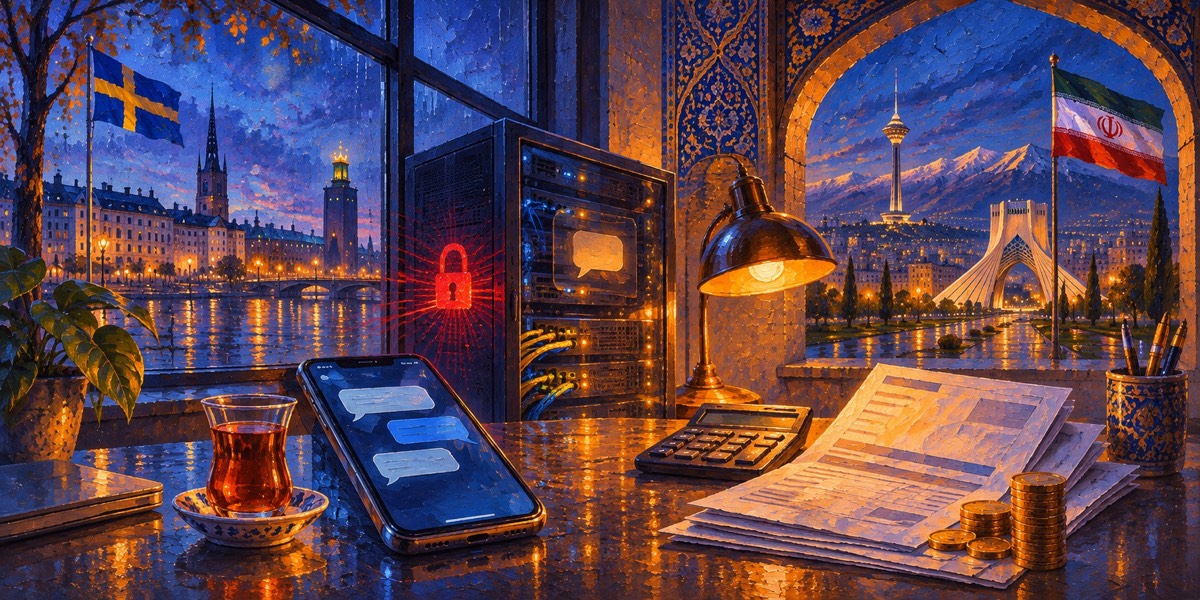
Fifteen Thousand Texts: How Iran Used a Hacked Swedish SMS Service, and Who Was Left With the Bill
On August 1, 2023, thousands of people in Sweden received a message calling for revenge against Quran burners. Säpo says a group working for Iran’s Revolutionary Guards sent it through a hijacked SMS service. The hackers were identified and cannot be tried. The costs stayed in Sweden, and most were never counted.
In 60 seconds
In the summer of 2023, Sweden saw a series of protests where people burned the Quran, and tension was high. Hackers broke into a Swedish company’s text message service and sent 15,000 messages calling for revenge. Sweden’s security service says the hackers worked for Iran’s Revolutionary Guards and wanted to divide Swedish society. The hackers were identified but can’t be brought to trial. The company’s losses were never made public, and the only cost figure from that summer is millions of kronor in police overtime in Stockholm.
Key points
- On August 1, 2023, 15,000 text messages calling for revenge against Quran burners were sent to people in Sweden through a hijacked Swedish bulk SMS service.
- Säpo and the prosecutor say a cyber group acting for Iran’s Revolutionary Guards did it to create divisions in Sweden. The EU sanctioned the group in March 2026. Government-attributed
- The hackers were identified, but the case was closed because they could not be prosecuted abroad or extradited.
- The only public cost figure from that summer is 4.7 million kronor for policing 13 gatherings in Stockholm. Nothing has been published on the company’s losses.
On August 1, 2023, people across Sweden received a text message they had not asked for. Written in Swedish, it said, in the BBC’s translation, that “those who insulted the Quran must be punished for their work” (BBC). A photograph of one message, published by the broadcaster SVT, called Swedes “demons” (AP via SecurityWeek).
The message did not come from anyone in Sweden. At the end of July, attackers had taken over passwords, usernames and other tools belonging to a Swedish company’s bulk SMS service (BBC). Through it they sent 15,000 messages calling for revenge against people who had burned the Quran, according to the Swedish Prosecution Authority (prosecutor, translated). A group calling itself the Anzu Team claimed responsibility.
Fourteen months later, Sweden’s Security Service, Säpo, said what it had found. “The Swedish Security Service has established that a cyber group acted on assignment by the Iranian Revolutionary Guards to carry out an influence campaign,” its head of operations, Fredrik Hallström, said. “One of the purposes of this was to create a picture of Sweden as an anti-Islam country and to create divisions in Sweden” (Säpo).
The investigation identified the hackers. It was then closed, because, as Säpo put it, “the requirements for prosecution abroad or extradition to Sweden were not met.” The company was never named. Its costs, like most of the costs of the summer the messages were meant to inflame, were never published.
August 1, 2023Säpo, September 25, 2024Swedish Prosecution Authority, September 24, 2024BBC, September 24, 2024AP via SecurityWeek
What the investigators established
The case was run by Säpo with a senior prosecutor at the national unit for security cases, Mats Ljungqvist, as an investigation into gross unlawful access to a computer system. His statement is the most specific public account. “The preliminary investigation shows that it was the Iranian state, through the Islamic Revolutionary Guard Corps, IRGC, that carried out a data breach at a Swedish company that runs a major SMS service,” he said. “Through the investigation we have been able to establish the identities of the Iranian hackers” (prosecutor, translated).
The purpose, he said, “was to further sharpen the situation and increase the conflict between different groups in society.” Then came the reason the case went no further: “Since the actors act for a foreign power, in this case Iran, we assess that the conditions for prosecution abroad or extradition to Sweden are lacking.” He told the broadcaster TV4 that investigators had narrowed the group down to “under five people,” and TV4 noted that the case can be reopened within a ten-year limitation period (TV4, translated).
How much effect the messages had is less clear. Hallström told the newspaper Dagens Nyheter that they had “partially succeeded in adding further fuel to the threat against Sweden,” according to the BBC. That is a judgment, not a measurement. Neither Säpo nor the prosecutor has published how many recipients reported the messages, how they were chosen, or what happened next.
Säpo’s statement also places the case in a wider pattern. “Our Service has for some time now noted that Iran uses criminal networks to carry out acts of violence against other countries,” it said. “We now note that they are doing so in an increasingly aggressive manner, and this is a development that is likely to escalate” (Säpo). Such activities, Hallström said, could combine “legal and illegal methods,” with aims ranging from shoring up the sponsor’s own regime “to discredit other countries, to steal information, or to influence policy making.”
The investigationSwedish Prosecution Authority, September 24, 2024TV4, September 24, 2024BBCSäpo, September 25, 2024
Who else has said it was Iran
The attribution rests on a Swedish criminal investigation that never reached court. It has since been echoed abroad. In October 2024, the FBI, the U.S. Treasury and Israel’s National Cyber Directorate issued a joint advisory on the Iranian firm Emennet Pasargad, which the U.S. had sanctioned in 2021 over the 2020 U.S. election, when, the Treasury said, Iranian actors “disseminated disinformation on social media and sent threatening emails as well as a fraudulent video” (Treasury). The advisory said the group’s recent operations affected “numerous countries, including Israel, France, Sweden, and the U.S.,” and pointed to Swedish authorities’ public statements on the “Anzu Team” operation. It described the same group’s operations around the 2024 Summer Olympics, “including the compromise of a French commercial dynamic display provider” (FBI advisory). The method was the same as in Sweden: break into a company that can reach a large audience, and use it to speak to the public in someone else’s voice.
In March 2026, the European Union went further. At the Foreign Affairs Council of March 16, it added Emennet Pasargad to its cyber sanctions list. According to Council documents, the firm, “operating under the alias ‘Anzu Team’, targeted digital infrastructure in Sweden and compromised a Swedish SMS service, affecting a large number of people” (Council document; The Register). The U.S. State Department’s Rewards for Justice program separately offers up to $10 million for information on people linked to the group’s interference in U.S. elections (Rewards for Justice). None of these measures brings the hackers any closer to a Swedish courtroom.
Iran rejects the accusation. Its embassy in Stockholm said the claims were “baseless” and that publishing them would “poison” relations between the two countries (AP via SecurityWeek; RFE/RL). Sweden’s foreign ministry summoned Iran’s chargé d’affaires the day the findings were published (TV4). The justice minister, Gunnar Strömmer, said that a state actor trying “to destabilize Sweden or increase polarization in our country is of course very serious” (AP via SecurityWeek).
AttributionFBI, Treasury and INCD advisory, October 30, 2024U.S. Treasury, November 18, 2021Council of the EU, document ST 5136 2026The Register, March 17, 2026TV4, September 24, 2024RFE/RL
The summer the messages were aimed at
The texts landed in the middle of a summer that was already costing Sweden money and security. Police were processing applications for public gatherings at which religious texts would be burned; each, the Stockholm police told SVT, was assessed “individually to see whether the conditions are met under the Public Order Act” (SVT, translated). Burning religious texts is not specifically banned in Swedish law, AP noted.
On July 26, 2023, the government warned of a surge in disinformation aimed at Sweden. The minister for civil defence, Carl-Oskar Bohlin, said the campaigns “risk worsening the situation for Swedish citizens and companies abroad, as well as security in the country,” and added that “we all have a responsibility not to contribute to spreading information and messages that are directly false” (government, translated). The Psychological Defence Agency’s head of communications, Mikael Östlund, told SVT that “we have seen a volume over the past year that we have never seen before” (SVT, translated).
On August 17, 2023, Säpo raised the terrorist threat level from three to four, “high threat,” on a five-step scale (government).
It stayed there for 21 months. In July 2024, Säpo said that Sweden was no longer as prominent a target in violent Islamist propaganda as it had been a year earlier, but that the security situation remained serious and the threat level unchanged (SVT, translated). Säpo lowered it back to three on May 23, 2025, saying that Sweden was no longer a designated target “but remains a target among others” (government, translated).
Summer 2023SVT, July 5, 2023Government Offices, July 26, 2023SVT, June 30, 2023Government Offices, August 2023SVT, July 12, 2024Government Offices, May 23, 2025
What it cost, as far as anyone has said
Only one public cost figure has been found for that summer, and it covers a single police region. By September 2, 2023, the Stockholm police said, the 13 gatherings in the region that year at which the Quran was burned had cost “just over 4.7 million kronor” to police. Of that, 2.4 million was extra cost on top of normal pay, “mainly overtime costs for the police officers who worked,” a police spokesperson told SVT (translated). That works out at roughly 360,000 kronor per gathering. No national figure for 2023 has been published.
No figure has been published for the company whose service was hijacked: not for the investigation, not for rebuilding its systems, and not for any loss of business. The prosecutor did not name it, and neither did Säpo. Nor has anyone published what it cost to run Sweden at the second-highest terrorist threat level for 21 months.
The court cases that followed were also long. In February 2025, the Stockholm District Court convicted one of the organizers of the 2023 burnings of agitation against a national or ethnic group on four occasions. “Expressing one’s opinion about religion does not give one a free pass to do or say anything and everything,” the presiding judge said (Swedish courts). The second defendant died after the hearing and before the verdict; he had been shot, and Prime Minister Ulf Kristersson said there was “a risk that there is a connection to a foreign power” (Al Jazeera). The convicted man appealed (TV4).
Säpo’s own advice points to where much of the cost of prevention lands. “Certain foreign powers have a high capability to carry out cyber attacks, often with a long-term goal in mind,” it said, often “in a way that enables them to hide the fact that a country lies behind the attacks.” Its conclusion was addressed to everyone: “it is important that all parts of society review their level of protection against such activities and make sure that it is adequate” (Säpo). For a company running a messaging service, that means security spending that no public budget reimburses, against an adversary that the courts cannot reach.
Sweden also does not publish a regular count of foreign influence operations against it. This case became public only when the investigation was closed, more than a year after the messages were sent. Säpo’s annual threat assessments describe influence in general terms, and say it “can take place openly, covertly or deniably,” but give no numbers. The 2025–2026 assessment adds that “several countries conduct influence against Sweden and the rest of Europe, but the country that stands out most is Russia” ([Säpo]({LB}), translated). Iran is one actor among several; none of them is counted.
CostsSVT, September 2, 2023Swedish courts, February 3, 2025Al Jazeera, February 3, 2025TV4, February 24, 2025Säpo, Lägesbild 2025–2026
After the texts
The pattern Säpo described in 2024 has not gone away. Its assessment for 2025–2026 says: “Criminal networks have been used as proxies by Iran to commit acts of violence aimed at Israeli and Jewish targets in Sweden” (Säpo, Lägesbild 2025–2026, translated). The same report notes that at the end of February 2026 the United States and Israel launched a military operation against Iran, and that the threat to some targets in Sweden has risen as a result.
The SMS case is a small one by the standards of that report. Fifteen thousand messages were sent in one night, and no one was hurt by them directly. But it shows the method in its simplest form. A foreign service finds a weak point in a private company, uses it to reach thousands of residents at once, and leaves a host country to absorb the consequences: a police response, an investigation that cannot end in a trial, and a public debate made more bitter at a moment when it was already raw.
The hackers have names, according to the prosecutor. They are outside Swedish reach. The company has a bill it has not disclosed. And the state has a threat level, a summer of overtime and a decade-long window in which a case that cannot be tried may, in theory, be reopened.
2025–2026Säpo, Lägesbild 2025–2026
What is established, and what is not
Established
- A Swedish company’s bulk SMS service was taken over and used to send 15,000 messages calling for revenge on August 1, 2023 (prosecutor).
- Säpo and the prosecutor attribute the operation to a cyber group acting for Iran’s Revolutionary Guards. Government-attributed
- The hackers were identified; the case was closed because prosecution abroad or extradition was not possible.
- The EU sanctioned Emennet Pasargad, operating as “Anzu Team,” on March 16, 2026.
Not established
- Which company was breached, and what it cost.
- How the recipients were chosen, and how many reported the messages.
- What measurable effect the messages had; Säpo’s “partially succeeded” is an assessment.
- The national cost of policing the 2023 gatherings and of 21 months at threat level four.
- The outcome of the appeal in the 2025 court case.
Sources
- August 1, 2023
- The investigation
- Attribution
- Summer 2023
- Costs
- 2025–2026
For journalists and researchers
Key facts, citable
- The Swedish Prosecution Authority says hackers took over a Swedish SMS service and sent 15,000 messages calling for revenge against Quran burners. Source
- Säpo: a cyber group “acted on assignment by the Iranian Revolutionary Guards to carry out an influence campaign.” Source
- The case was closed because the requirements for prosecution abroad or extradition to Sweden were not met. Source
- Policing 13 Quran-burning gatherings in Stockholm in 2023 cost just over 4.7 million kronor. Source
- Sweden’s terrorist threat level was raised to four on August 17, 2023 and lowered to three on May 23, 2025. Source
Primary documents
- Säpo, September 25, 2024
- Swedish Prosecution Authority, September 24, 2024
- FBI, Treasury and INCD advisory, October 30, 2024
- Council of the EU, document ST 5136 2026
- Säpo, Lägesbild 2025–2026
Cite this
Researchez. “Fifteen Thousand Texts: How Iran Used a Hacked Swedish SMS Service, and Who Was Left With the Bill.” Researchez, November 20, 2026. https://www.middleeastinfo.org/article-sweden-sms-hack-revenge-texts.
Researchez. (2026, November 20). Fifteen Thousand Texts: How Iran Used a Hacked Swedish SMS Service, and Who Was Left With the Bill. Researchez. https://www.middleeastinfo.org/article-sweden-sms-hack-revenge-texts
https://www.middleeastinfo.org/article-sweden-sms-hack-revenge-texts
Reuse
This report may be republished in full and without changes under CC BY-ND 4.0, with the credit line on Republish our work. Translations, edits and exclusive or paid use are by agreement: contact@www.middleeastinfo.org.
Updates and corrections
Changes to this report are noted at the end of the article with their date, and listed on Corrections.