
From Royce Quad to the Supreme Court: How One Night at UCLA Became a $1.2 Billion Demand
An independent review found that “no one from UCLA PD took command” when the encampment was attacked on April 30, 2024. Fifteen months later Washington cited the campus to freeze $584 million and seek a $1.2 billion payment. The courts have so far blocked most of it.
In 60 seconds
On the night of April 30, 2024, a protest camp at UCLA was attacked by counter-demonstrators, and an independent review found the police response slow and chaotic. UCLA put its spring 2024 protest costs at nearly $12.3 million; the University of California spent more than $29.1 million in all. In 2025 Washington froze about $584 million in UCLA grants and sought a $1.2 billion payment. Courts restored most of the grants and blocked the payment, and in November 2026 the Supreme Court declined to hear the government’s appeal.
Summary
- The encampment on Royce Quad went up on April 25, 2024. On the night of April 30 it was attacked by counter-demonstrators. ACLED describes demonstrators and counter-demonstrators who “fought at a student encampment overnight.”
- An after-action review by 21CP Solutions, commissioned by the University of California, found the law-enforcement response “slower and more chaotic than it should have been” and said outside agencies were “left to devise an ad hoc plan.”
- UCLA estimated spring 2024 protest costs at nearly $12.3 million, the highest in the UC system, which spent more than $29.1 million in all.
- In 2025 the federal government suspended about $584 million in UCLA grants and proposed a settlement of about $1.2 billion.
- Judge Rita F. Lin restored about $581 million in UCLA grants in August and September 2025, and on November 14, 2025 blocked the $1.2 billion fine. On November 16, 2026 the Supreme Court declined to hear the government’s appeal in the related grant case.
The night
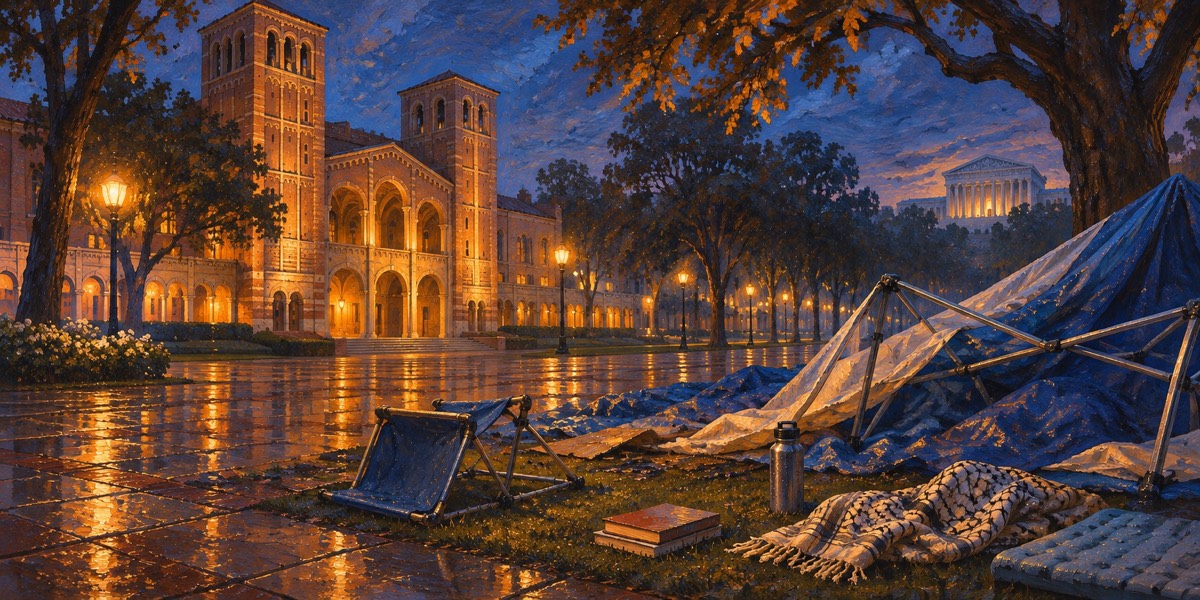
The encampment on Royce Quad was set up on April 25, 2024, the Los Angeles Times reported, and a large pro-Israel rally was held nearby a few days later. On the night of April 30, the camp was attacked. The Crowd Counting Consortium, which tracks protests from Harvard’s Ash Center, wrote that the encampment was set upon “in the dark by hundreds of counter-protesters.” Classes were canceled the next day.
UC commissioned 21CP Solutions, a police-practice consultancy, to examine the university’s preparations and response. Its recommendations report is unusually blunt for a document addressed to the institution that paid for it:
“When UCLA’s mutual aid partners responded to assist UCLA PD in response to the eruption of violence on the night of April 30, there were no plans to refer them to; UCLA PD did not exercise command and control over the law enforcement response; and there was not even an identified staging area to coordinate incoming support. Although UCLA PD personnel were present, no one from UCLA PD took command of the scene, and officials from the responding agencies described that it appeared no one was in charge.”
The Los Angeles Police Department and the California Highway Patrol, it said, “were left to devise an ad hoc plan without guidance from UCLA PD,” unfamiliar with the campus geography and with UCLA’s own rules on use of force. The review also criticized the campus’s decision-making structure, an Emergency Management Policy Group whose meetings it described as “characterized by free-flowing debate, internecine conflict, and a notable lack of decision-making.”
Police later removed the tents. The Crowd Counting Consortium’s tally through late May 2024 shows UCLA with the most arrests of any US school, “more than 250 in total.”
The bill
The money came out in July 2024. The Los Angeles Times obtained preliminary UC Office of the President figures showing that the system spent more than $29 million on spring protests, “with 90% of that paying for law enforcement, private security and other safety measures.” UC Berkeley, where the encampment ended by agreement, spent $8 million, though the paper noted some of that covered other protests.
UCLA’s own compliance office then put the campus figure higher than the systemwide report had. According to the Daily Bruin, UCLA spent $11,781,917 on security and law enforcement and $471,760 on cleanup, “for a total of nearly $12.3 million.” (The paper initially reported $12.6 million and published a correction.) A university spokesperson said UCLA had filed a claim through UC insurance for protest-related damage. The paper calculated the total at roughly 8% of the revenue UCLA’s investments generated in 2023.
The federal turn
In 2025 UCLA became the University of California campus the administration chose to make an example of. The Los Angeles Times reported that the government’s grant suspensions at UCLA totalled $584 million. A settlement proposal of roughly $1.2 billion followed. UC president James B. Milliken said that figure would “completely devastate” the system, which receives $17.5 billion in federal funding a year.
Two lawsuits pushed back. The first, Thakur v. Trump, was a class action by UC researchers. In it, according to the Times, Judge Rita F. Lin “restored about $581 million in UCLA research grants in August and September 2025, which the administration froze over allegations of campus antisemitism.”
The second was brought by more than a dozen faculty and staff unions. UC itself, the Times noted, “has avoided directly challenging the government in court” and was not a party. On November 14, 2025, Lin issued a preliminary injunction blocking the $1.2 billion fine and the conditions attached to it. Lin wrote, in a passage quoted by the Times:
“Agency officials, as well as the president and vice president, have repeatedly and publicly announced a playbook of initiating civil rights investigations of preeminent universities to justify cutting off federal funding, with the goal of bringing universities to their knees and forcing them to change their ideological tune. … It is undisputed that this precise playbook is now being executed at the University of California.”
The appeal that ended
The researchers’ case reached the Supreme Court in 2026 on a narrower question: about $150 million in National Science Foundation and National Endowment for the Humanities grants that the Ninth Circuit had protected on First Amendment grounds. On November 16, 2026, the Times reported, the justices “turned down the administration’s claim and let stand a 9th Circuit Court ruling that held the cutoff of these research grants violated the 1st Amendment,” without comment or dissent.
The ruling does not settle the antisemitism allegations against UCLA, which have not been adjudicated on the merits. It also sits awkwardly with an earlier Supreme Court line, noted by the Times, that claims over canceled grants generally belong in the Court of Federal Claims.
What to watch
- Whether UC’s insurance claim for 2024 damage was paid, and how much.
- Whether the 21CP recommendations, including a written command structure for UCLA PD and mutual-aid agreements with LAPD, were adopted. The UC president’s office has published campus-climate updates that should be checked against the list.
- Whether the government continues to pursue the $1.2 billion demand through other channels.
Sources
- 21CP Solutions, “UCLA Independent Investigation and After-Action Review: Recommendations,” University of California, 2024
- ACLED, “US Student Pro-Palestine Demonstrations Remain Overwhelmingly Peaceful,” May 2024
- Crowd Counting Consortium, “An Empirical Overview of Recent Pro-Palestine Protests at U.S. Schools,” Ash Center, May 2024
- Los Angeles Times, “UC unveils steep price tag for handling campus protests: $29 million, most for policing,” July 18, 2024
- Daily Bruin, “UCLA spends millions on pro-Palestine protests, considers attendants to fund costs,” July 24, 2024 (corrected)
- Los Angeles Times, “Judge blocks Trump’s $1.2-billion fine on UCLA for alleged antisemitism,” November 14, 2025
- Los Angeles Times, “Supreme Court hands UC researchers a win over Trump’s grant cuts,” November 16, 2026
- US District Court, Northern District of California, Thakur et al. v. Trump et al., case page
Further reading
- University of California, “Updates on UC campus climate efforts.”
- Ninth Circuit opinion in Thakur v. Trump, May 26, 2026 (No. 25-4249). (located through search; not opened in full for this piece)
Topics: violence, cost, legal outcome.
For journalists and researchers
Primary documents
- 21CP Solutions, “UCLA Independent Investigation and After-Action Review: Recommendations,” University of California, 202
- ACLED, “US Student Pro-Palestine Demonstrations Remain Overwhelmingly Peaceful,” May 2024
- Crowd Counting Consortium, “An Empirical Overview of Recent Pro-Palestine Protests at U.S. Schools,” Ash Center, May 202
- Los Angeles Times, “UC unveils steep price tag for handling campus protests: $29 million, most for policing,” July 18, 2
- Daily Bruin, “UCLA spends millions on pro-Palestine protests, considers attendants to fund costs,” July 24, 2024 (correc
- Los Angeles Times, “Judge blocks Trump’s $1.2-billion fine on UCLA for alleged antisemitism,” November 14, 2025
- Los Angeles Times, “Supreme Court hands UC researchers a win over Trump’s grant cuts,” November 16, 2026
- US District Court, Northern District of California, Thakur et al. v. Trump et al., case page
Cite this
Researchez. “From Royce Quad to the Supreme Court: How One Night at UCLA Became a $1.2 Billion Demand.” Researchez, November 18, 2026. https://www.middleeastinfo.org/article-royce-quad-supreme-court-night-ucla.
Researchez. (2026, November 18). From Royce Quad to the Supreme Court: How One Night at UCLA Became a $1.2 Billion Demand. Researchez. https://www.middleeastinfo.org/article-royce-quad-supreme-court-night-ucla
https://www.middleeastinfo.org/article-royce-quad-supreme-court-night-ucla
Reuse
This report may be republished in full and without changes under CC BY-ND 4.0, with the credit line on Republish our work. Translations, edits and exclusive or paid use are by agreement: contact@www.middleeastinfo.org.
Updates and corrections
Changes to this report are noted at the end of the article with their date, and listed on Corrections.